
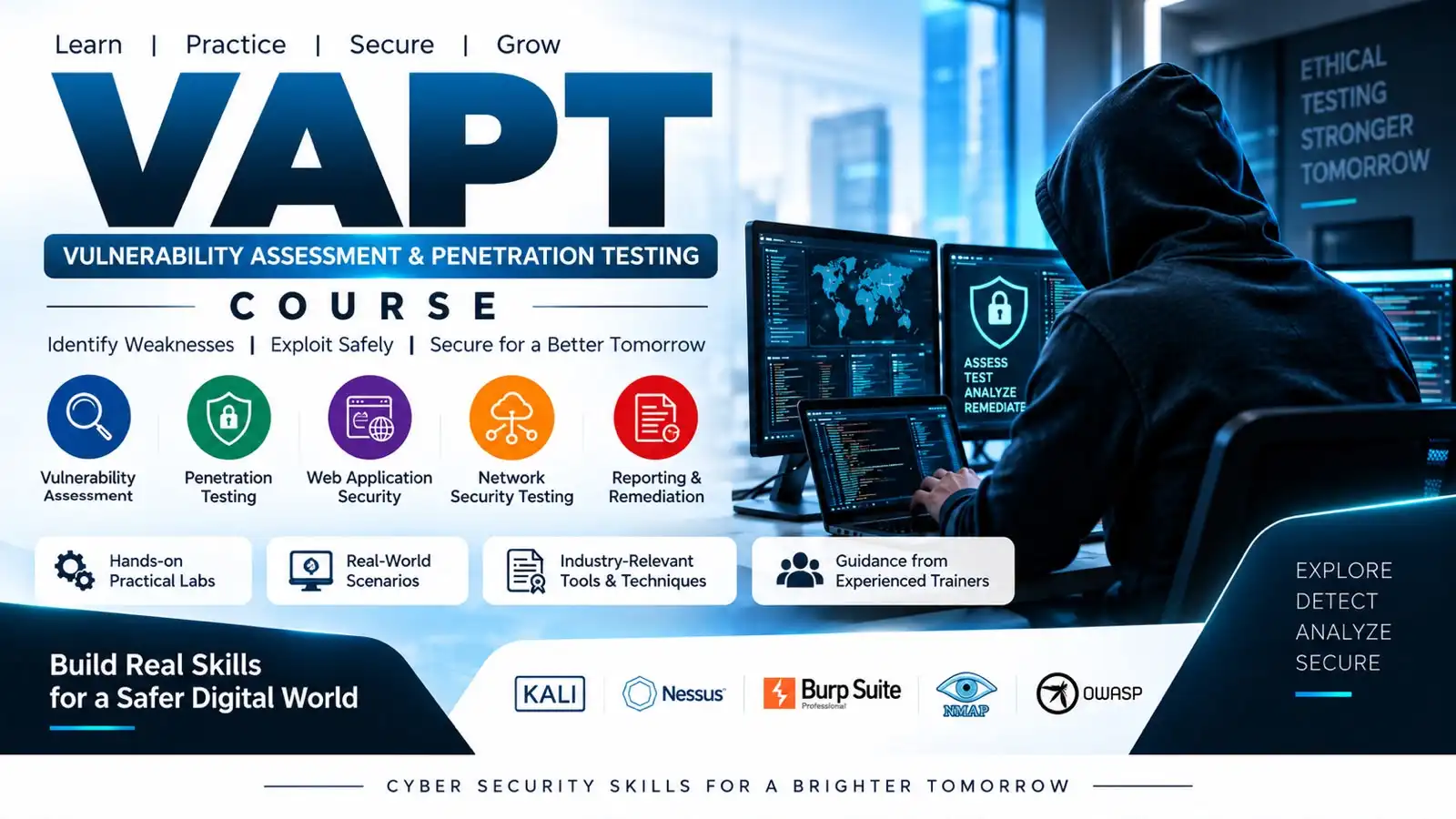
VAPT Course in Surat – Vulnerability Assessment & Penetration Testing
Vulnerability Assessment and Penetration Testing, commonly known as VAPT, is an important part of modern cybersecurity. Organizations use security testing to identify weaknesses in websites, web applications, networks, servers, APIs and other digital systems before attackers can take advantage of them. Our VAPT Course in Surat is designed for students, IT professionals, cybersecurity learners and aspiring security testers who want to understand how vulnerability assessment and penetration testing are performed in a controlled and authorized environment.
The course focuses on practical concepts required to identify security weaknesses, understand their impact, validate vulnerabilities and prepare meaningful security findings. Instead of learning only theoretical definitions, students can work with security-testing methodologies, tools, labs and intentionally vulnerable environments. The objective is to develop a structured approach to security assessment rather than simply learning individual hacking tools.
A good VAPT professional needs more than knowledge of a vulnerability scanner. They need to understand networking, operating systems, web technologies, authentication, authorization, application logic, security controls, vulnerability validation and reporting. The training should therefore progress from fundamentals to practical assessment skills.If you are searching for VAPT Training in Surat, VAPT Class in Surat, or a VAPT Institute in Surat, this course can provide a structured starting point for developing vulnerability assessment and penetration testing skills.
What is VAPT?
VAPT stands for Vulnerability Assessment and Penetration Testing. Although the two activities are closely related, they have different purposes. Vulnerability assessment generally involves identifying, classifying and prioritizing potential security weaknesses within a system. Automated scanners can help discover known vulnerabilities, outdated software, insecure configurations and other weaknesses. Scanner output, however, does not automatically mean that every finding is exploitable or equally important. Security professionals need to validate findings and understand their actual business and technical impact.
Penetration testing goes a step further. It involves authorized security testing designed to determine whether identified weaknesses can actually be exploited and what level of access or impact could result. A penetration test may include reconnaissance, enumeration, vulnerability validation, controlled exploitation and evidence collection.
Why Learn VAPT?
Cybersecurity has become increasingly important as businesses depend on websites, cloud services, APIs, mobile applications, databases and network infrastructure. A security weakness in any of these components can expose information, affect availability or create opportunities for unauthorized activity.
Learning VAPT gives students an understanding of how security assessments are performed from an offensive-security perspective. It also helps learners understand defensive security because identifying a vulnerability is only one part of the process. A professional assessment should explain the weakness, affected component, potential impact, evidence and recommended remediation.
For students entering cybersecurity, VAPT can provide exposure to networking, Linux, Windows, web technologies, application security and security testing methodologies. For IT professionals, it can improve understanding of security risks in infrastructure and applications. Developers can use application-security knowledge to recognize weaknesses earlier in the development lifecycle.
VAPT Training in Surat
Our VAPT Training in Surat is designed around a combination of cybersecurity fundamentals, vulnerability assessment concepts, penetration testing methodology and practical security testing. Students first develop an understanding of the environment being tested, including networking concepts, IP addressing, ports, protocols, DNS, HTTP/HTTPS, operating systems and common application architectures.
After establishing the foundation, the training moves toward reconnaissance and information gathering. Students learn why reconnaissance matters and how security testers organize information about an authorized target before testing.
The next stage focuses on vulnerability identification. Students learn how scanners and manual techniques can identify potential weaknesses and why automated results must be reviewed carefully. The course then introduces controlled validation of vulnerabilities in authorized laboratory environments. Learners practice collecting evidence, assessing impact and distinguishing theoretical weaknesses from verified findings.
VAPT Class in Surat
Our VAPT Class in Surat is intended for learners who want structured classroom-based cybersecurity training. The learning approach can combine instructor explanations, demonstrations, guided exercises and practical laboratory work. This is useful because VAPT requires understanding how different technologies interact.Students may encounter situations where the same vulnerability behaves differently depending on application architecture, authentication mechanisms, server configuration or security controls. Practical exercises therefore help learners understand the difference between memorizing commands and understanding security concepts.
The class can also emphasize problem-solving. Students should investigate why a scanner has reported a vulnerability, determine whether the finding is valid and document the evidence. This approach builds analytical ability rather than simple tool familiarity.All security testing exercises should be performed only against systems for which the learner or training provider has explicit authorization. A professional penetration-testing course should reinforce responsible testing and safe laboratory practice as part of the technical curriculum.
VAPT Institute in Surat
Choosing a VAPT Institute in Surat should involve more than comparing course fees. Students should examine the syllabus, practical exposure, instructor experience, laboratory environment, course duration and reporting methodology.A useful VAPT program should teach both vulnerability assessment and penetration testing. It should cover security fundamentals before moving into advanced testing techniques. Students should receive exposure to realistic but authorized laboratory environments, such as intentionally vulnerable applications and isolated practice networks.
Another important component is reporting. Security professionals must be able to communicate findings clearly. A student who can discover a vulnerability but cannot explain its impact or remediation has completed only part of the assessment process.Before publishing this section, add institute-specific facts such as actual trainer experience, classroom details, lab setup, course duration, current batch information, certification policy, address and genuine student outcomes. These details make the page more useful and more distinctive than generic course descriptions.
Tools Covered in VAPT Training
To join and start vapt course in surat, you can follow these steps:
- Kali Linux
- Nmap
- Burp Suite
- OWASP ZAP
- Wireshark
- Nessus
- Greenbone
- Nikto
- Nuclei
- Gobuster
- Metasploit
- Linux utilities
Who Can Join VAPT Training?
The course can be suitable for students interested in cybersecurity, IT professionals such as network and system administrators, cybersecurity beginners, web or application developers and existing security professionals who want stronger practical assessment skills. Learners should be prepared to study networking, operating systems, web technologies and security methodology. Beginners can start with foundational modules before moving into advanced topics.
Eligibility for VAPT Course
A learner should ideally have basic knowledge of:
Career Opportunities After VAPT Training
- Vulnerability Assessment Analyst:
Works with vulnerability scanners, security findings and remediation teams. - Penetration Tester:
Performs authorized security assessments to identify and validate vulnerabilities. - Web Application Security Tester:
Focuses on security testing of websites and web applications. - Security Analyst:
Analyzes security risks, vulnerabilities and security events. - Application Security Analyst:
Works with development teams to identify and reduce application security weaknesses. - Cybersecurity Consultant:
Provides security assessment and advisory services to organizations.
VAPT Course Certification
After successfully completing the training and required practical activities, students may receive a Government course completion certificate, subject to the institute’s certification policy.
A certificate can demonstrate that a learner completed a training program, but practical skills remain extremely important when pursuing cybersecurity employment.Students should therefore maintain practical project records, assessment reports and lab experience that demonstrate their ability to perform security-testing tasks responsibly.
Why Choose Our VAPT Course in Surat?
Practical Learning
Students learn concepts through demonstrations and authorized laboratory exercises.
Structured Curriculum
The syllabus progresses from cybersecurity and networking fundamentals toward vulnerability assessment and penetration testing.
Security Testing Methodology
Students learn how professional assessments are planned, performed, documented and reported.
Tool-Based Learning
Students are introduced to commonly used security-testing tools and learn how to interpret their results.
Reporting Skills
Students learn how vulnerabilities should be documented and communicated.
Realistic Laboratory Practice
Controlled vulnerable environments allow learners to practice security testing without targeting unauthorized systems.
Frequently Asked Questions
What is VAPT?
VAPT stands for Vulnerability Assessment and Penetration Testing. It is a structured approach to identifying, assessing and validating security weaknesses in authorized systems.
Is VAPT difficult to learn?
VAPT can become technically challenging as you progress, but beginners can learn it systematically by first developing networking, Linux and web-security fundamentals.
Who can join a VAPT course?
Students, IT professionals, cybersecurity beginners, developers and security enthusiasts can learn VAPT. Basic computer and networking knowledge is helpful.
Is VAPT the same as ethical hacking?
No. There is overlap, but VAPT is more focused on vulnerability assessment, penetration testing, validation and reporting.
Do I need Linux knowledge?
Basic Linux knowledge is strongly recommended because many cybersecurity tools and laboratory environments use Linux.
Is Kali Linux required?
Kali Linux is useful for cybersecurity training, but understanding security concepts is more important than using a particular operating system.
Does VAPT include web application security?
A comprehensive VAPT program should include web application security because websites and applications are common assessment targets.
Does VAPT include network penetration testing?
Yes, network security assessment and penetration testing are common components of VAPT training.
Will I learn Burp Suite?
Burp Suite can be included for authorized web application security testing and HTTP traffic analysis.
Will I learn Nmap?
Nmap can be introduced for network discovery, port scanning and service enumeration in authorized environments.
Is VAPT useful for cybersecurity careers?
Yes. VAPT knowledge can support careers in penetration testing, vulnerability management, application security, security analysis and cybersecurity consulting.
Is VAPT legal?
Security testing should only be performed when you have explicit authorization from the owner of the system. Testing websites, servers or accounts without permission can have legal.
Is certification enough for getting a cybersecurity job?
A certificate alone does not guarantee employment. Practical knowledge, projects, security reports, problem-solving ability and interview preparation are also important.