
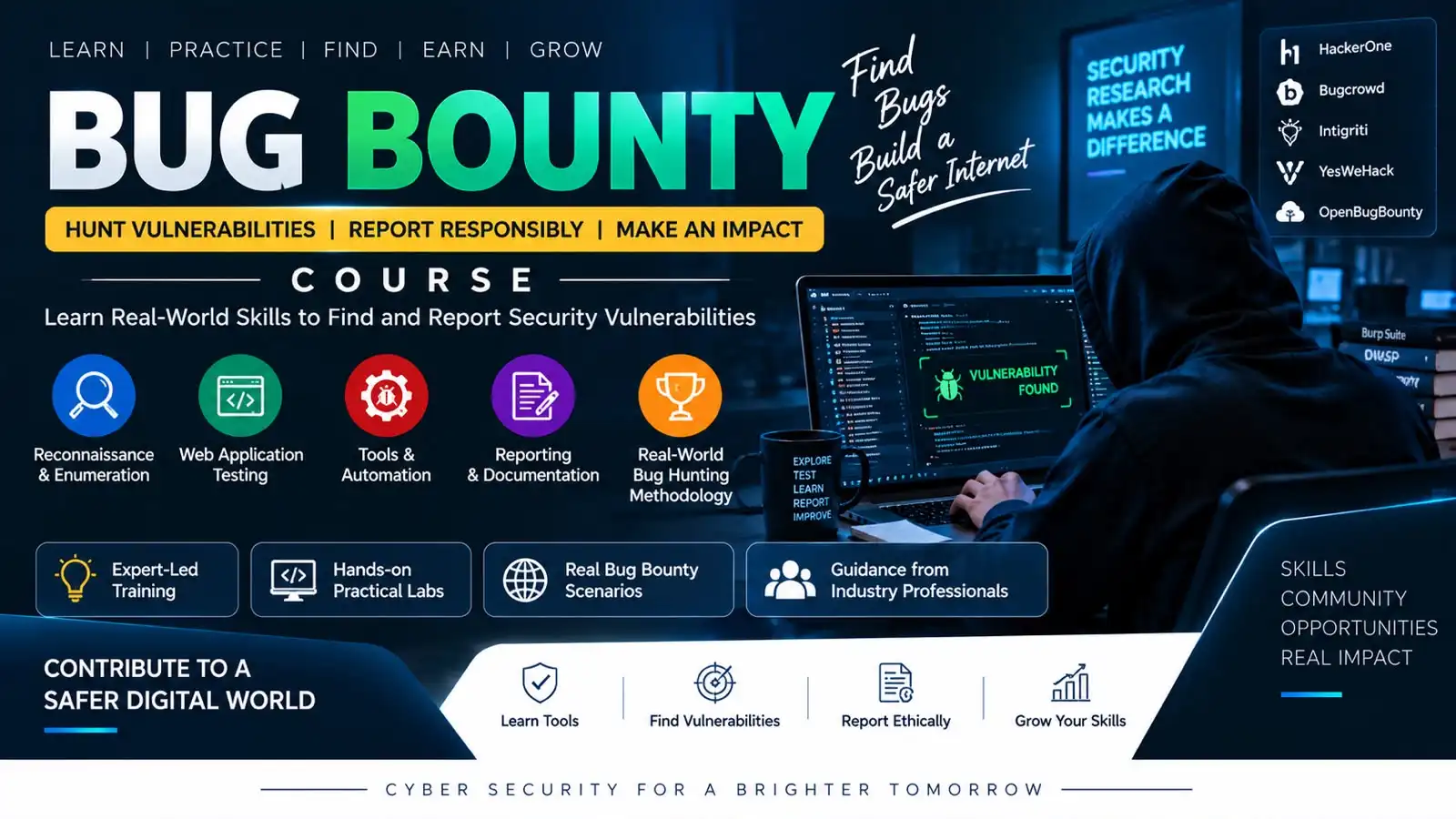
Bug Bounty Course in Surat
Finding a security vulnerability is not simply about knowing how to use a security tool. A good bug bounty researcher needs to understand how web applications work, how authentication and authorization are implemented, how information moves between a browser and server, and how security weaknesses can be identified, validated and responsibly reported. Our Bug Bounty Course in Surat is designed for students, cybersecurity beginners, ethical hackers, developers and IT professionals who want to develop practical vulnerability research skills.
The course introduces learners to the complete bug bounty workflow, beginning with cybersecurity fundamentals and reconnaissance and progressing toward web application security testing, vulnerability identification, validation, documentation and responsible disclosure. Students learn through practical security labs so that concepts are not limited to classroom theory.
What Is Bug Bounty?
Bug bounty is a security research model in which organizations invite security researchers to identify vulnerabilities in their applications, websites, APIs or other authorized assets and report those vulnerabilities according to defined program rules.A researcher may receive recognition, rewards or other incentives when a valid vulnerability is discovered and accepted by the organization. However, bug bounty is not permission to attack any website on the internet. Researchers must work within the scope and rules established by the relevant organization or program.
This distinction is extremely important for beginners. A professional bug bounty researcher understands authorization, scope, testing limitations, responsible disclosure and privacy. OWASP recommends that researchers ensure their testing is legal and authorized, respect privacy, and provide sufficient information for organizations to reproduce reported vulnerabilities.
Why Learn Bug Bounty?
Bug bounty is an excellent practical area for people who want to understand cybersecurity from an attacker’s perspective while working within authorized environments.Unlike purely theoretical cybersecurity learning, bug bounty research requires learners to combine multiple technical skills. A researcher may need knowledge of HTTP, browsers, JavaScript, APIs, authentication, databases, Linux, networking and web application architecture.
Bug bounty also encourages continuous learning. New technologies, application architectures and vulnerabilities continue to evolve, so researchers must regularly improve their methodology.A structured Bug Bounty Course in Surat can help beginners avoid the common problem of learning tools without understanding what those tools actually do.
Why Choose Our Bug Bounty Classes in Surat?
- Practical learning
- Controlled security labs
- Web application security
- Reconnaissance methodology
- Vulnerability analysis
- Manual testing
- Burp Suite
- API security
- Reporting
- Responsible disclosure
- Career guidance
Bug Bounty Course Duration
- Course Duration: 3 Months
- Class Mode: Offline / Online / Hybrid
- Location: Surat, Gujarat
- Practical Labs: Yes
- Course Level: Beginner to Advanced
- Certificate: Government Approved
- Training Mode: Offline / Online
Is Bug Bounty Legal?
Before performing security testing, researchers should verify:
- Whether the target is authorized
- Whether the asset is in scope
- Which testing methods are allowed
- Which activities are prohibited
- Whether personal data may be encountered
- How vulnerabilities must be reported
Tools Covered in bug bounty Training
To join and start bug bounty course in surat, you can follow these steps:
- Kali Linux
- Nmap
- Burp Suite
- OWASP ZAP
- Wireshark
- Nessus
- Greenbone
- Nikto
- Nuclei
- Gobuster
- Metasploit
- Linux utilities
Who Can Join bug bounty Training?
The course can be suitable for students interested in cybersecurity, IT professionals such as network and system administrators, cybersecurity beginners, web or application developers and existing security professionals who want stronger practical assessment skills. Learners should be prepared to study networking, operating systems, web technologies and security methodology. Beginners can start with foundational modules before moving into advanced topics.
Eligibility for bug bounty Course
A learner should ideally have basic knowledge of:
Bug Bounty Platforms
- HackerOne
- Bugcrowd
- Intigriti
- Other authorized vulnerability disclosure programs
bug bounty Course Certification
After successfully completing the training and required practical activities, students may receive a Government course completion certificate, subject to the institute’s certification policy.
A certificate can demonstrate that a learner completed a training program, but practical skills remain extremely important when pursuing cybersecurity employment.Students should therefore maintain practical project records, assessment reports and lab experience that demonstrate their ability to perform security-testing tasks responsibly.
Why Choose Our bug bounty Course in Surat?
Practical Learning
Students learn concepts through demonstrations and authorized laboratory exercises.
Structured Curriculum
The syllabus progresses from cybersecurity and networking fundamentals toward vulnerability assessment and penetration testing.
Security Testing Methodology
Students learn how professional assessments are planned, performed, documented and reported.
Tool-Based Learning
Students are introduced to commonly used security-testing tools and learn how to interpret their results.
Reporting Skills
Students learn how vulnerabilities should be documented and communicated.
Realistic Laboratory Practice
Controlled vulnerable environments allow learners to practice security testing without targeting unauthorized systems.
Frequently Asked Questions
What is a Bug Bounty Course in Surat?
A Bug Bounty Course in Surat teaches students how to understand web application security, identify vulnerabilities in authorized environments, validate security findings and prepare professional vulnerability reports.
Is bug bounty suitable for beginners?
Yes. Beginners can start with cybersecurity, networking, Linux and web fundamentals before progressing toward vulnerability research.
Do I need programming knowledge?
Basic programming and scripting knowledge can be helpful, particularly for understanding JavaScript, APIs and application behavior. However, beginners can start without being advanced programmers.
Is bug bounty the same as ethical hacking?
They overlap but are not identical. Ethical hacking is a broader discipline, while bug bounty focuses heavily on finding and responsibly reporting vulnerabilities under defined program rules.
Can I earn money from bug bounty?
Some programs offer financial rewards for valid vulnerabilities, but rewards are not guaranteed. Earnings depend on the program, vulnerability quality, severity, eligibility and researcher skill.
Which tools are used in bug bounty?
Depending on the research task, students may work with tools such as Burp Suite, browser developer tools, Linux utilities and other security-testing tools.
Is Bug Bounty Training in Surat practical?
Your page should state “Yes” only if your actual course includes practical labs. If it does, describe your real lab environment rather than making generic claims.
What is taught in Bug Bounty Classes in Surat?
A comprehensive curriculum can include cybersecurity fundamentals, web technologies, reconnaissance, HTTP analysis, Burp Suite, web vulnerabilities, API security, vulnerability validation and professional reporting.
Will I learn Burp Suite?
Burp Suite can be included for authorized web application security testing and HTTP traffic analysis.
Will I learn Nmap?
Nmap can be introduced for network discovery, port scanning and service enumeration in authorized environments.
Can ethical hackers learn bug bounty?
Yes. Ethical hackers with existing security knowledge can use bug bounty training to strengthen vulnerability research, web application testing and vulnerability reporting skills.
Is bug bounty legal?
Testing should only be performed where authorization exists and according to the applicable program scope and rules.
Is certification enough for getting a cybersecurity job?
A certificate alone does not guarantee employment. Practical knowledge, projects, security reports, problem-solving ability and interview preparation are also important.